<?xml version="1.0" encoding="utf-8"?><feed xmlns="http://www.w3.org/2005/Atom" ><generator uri="https://jekyllrb.com/" version="3.10.0">Jekyll</generator><link href="https://mjhung.com/feed.xml" rel="self" type="application/atom+xml" /><link href="https://mjhung.com/" rel="alternate" type="text/html" /><updated>2026-06-22T19:19:26+00:00</updated><id>https://mjhung.com/feed.xml</id><title type="html">Mitchell J. Hung</title><subtitle>Your Name&apos;s academic portfolio</subtitle><author><name>Mitchell J. Hung</name><email>mjhung@stanford.edu</email></author><entry><title type="html">“High-severity fire now dominant in California forests” now published in PNAS!</title><link href="https://mjhung.com/posts/2026/01/high-severity-fire-california/" rel="alternate" type="text/html" title="“High-severity fire now dominant in California forests” now published in PNAS!" /><published>2026-06-22T00:00:00+00:00</published><updated>2026-06-22T00:00:00+00:00</updated><id>https://mjhung.com/posts/2026/01/high-severity-fire-california</id><content type="html" xml:base="https://mjhung.com/posts/2026/01/high-severity-fire-california/"><![CDATA[<div style="display:flex; gap:2em; align-items:flex-start;">
  <div style="flex:0 0 40%;">
    <img src="/images/fig1_panel_a.png" alt="Annual forest area burned by severity class" style="width:100%; display:block;" />
    <img src="/images/fig1_panel_b.png" alt="Annual proportion burned by severity class" style="width:100%; display:block; margin-top:0.5em;" />
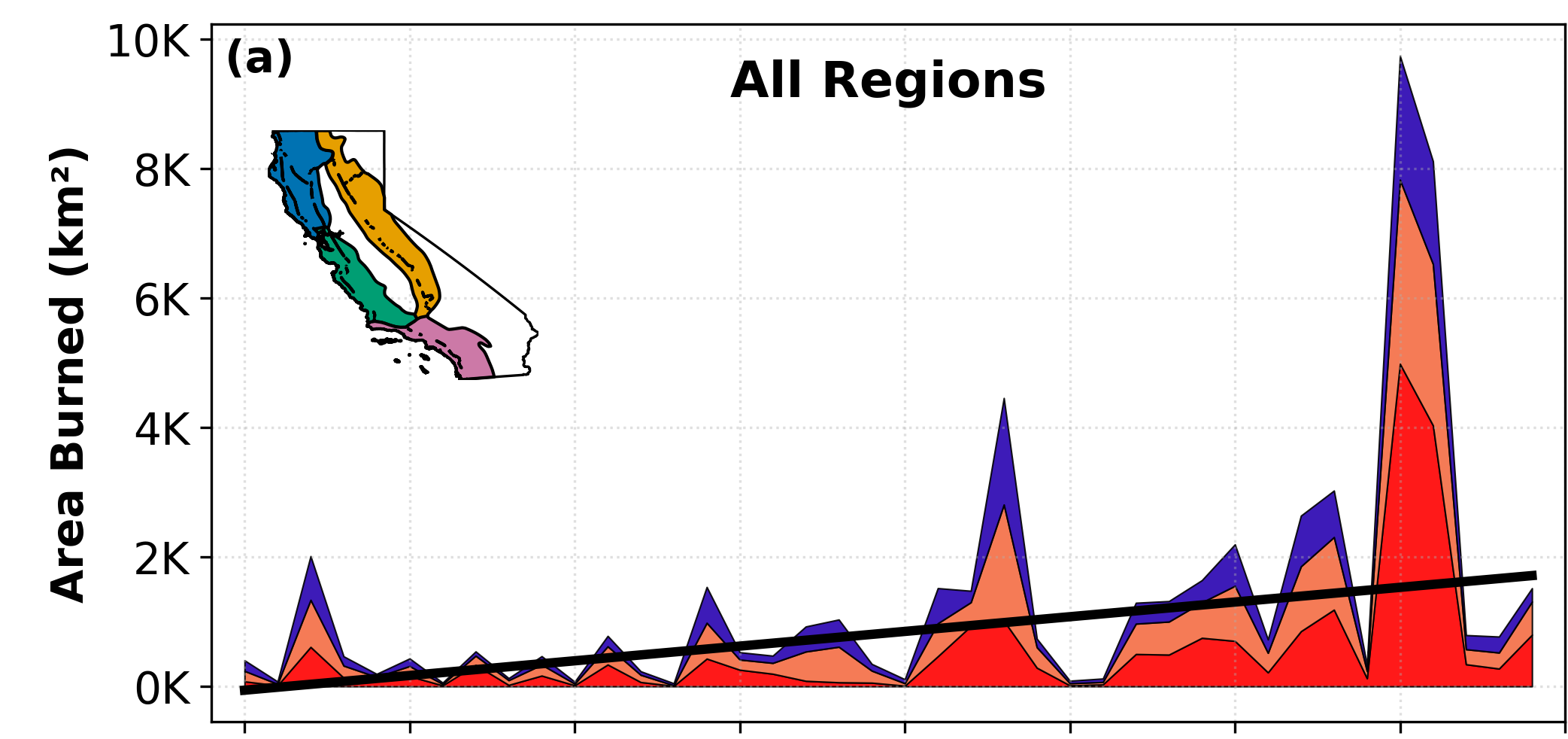
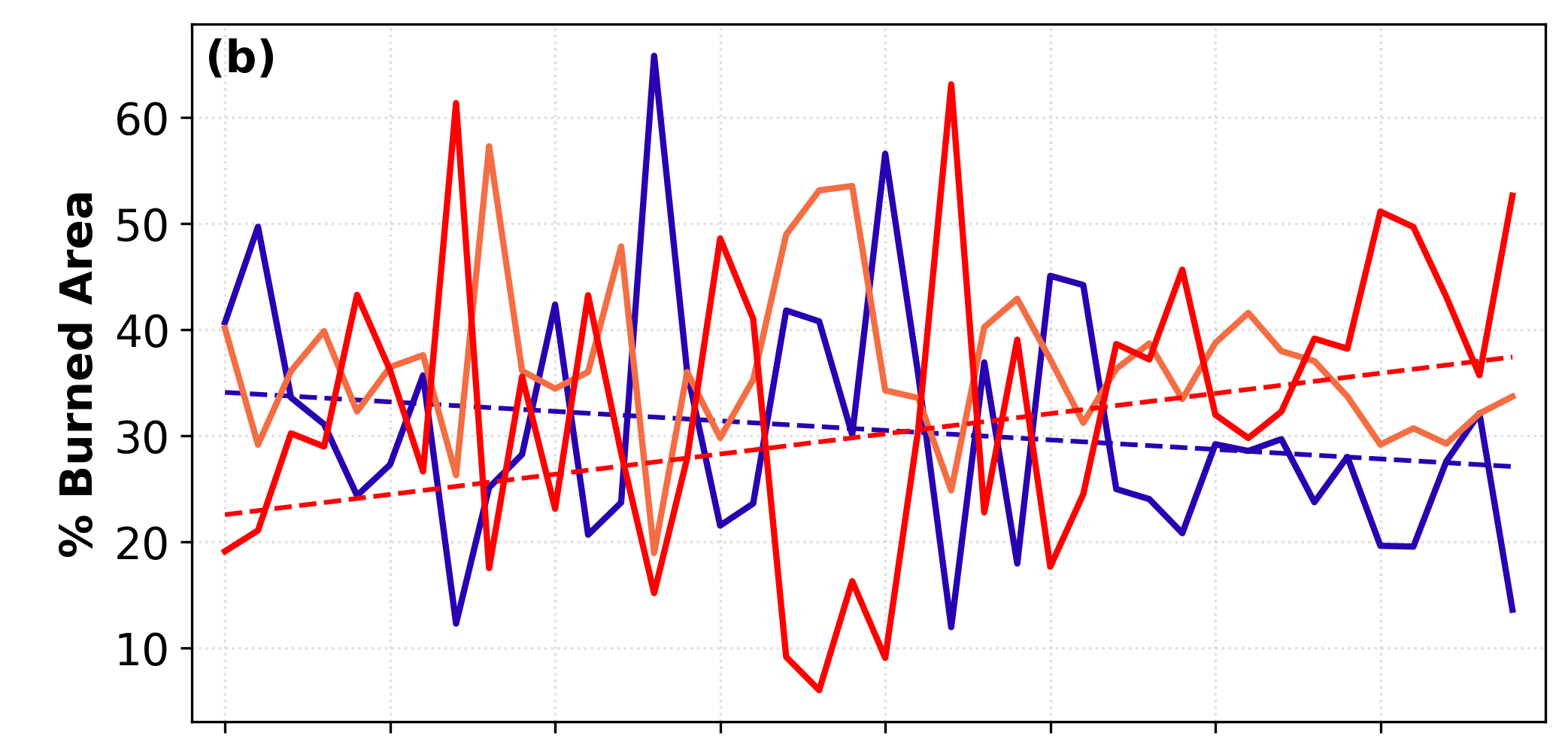
    <p style="font-size:0.85em; margin-top:0.5em;"><em>Time series of annual area burned at low (blue), moderate (orange), and high (red) severity (top), and the annual <em>proportion</em> burned at low, moderate, and high-severity (bottom).</em></p>
  </div>
  <div style="flex:1;">
    Fire severity exerts crucial ecological controls in many forests globally. In California, where annual forest-fire area has increased dramatically in recent decades, understanding how burn severity is changing is essential for informing environmental policy and management. We developed remotely sensed high-resolution maps of severity for 4,391 forest fires to assess trends and drivers of burn severity across California's forests from 1985–2024. We observed that historically dominant low-severity fire was increasingly replaced by high-severity stand-replacing fire, which became the most common severity class beginning in 2012. 

    <a href="https://www.pnas.org/doi/abs/10.1073/pnas.2532829123">Link to paper</a>.
  </div>
</div>]]></content><author><name>Mitchell J. Hung</name><email>mjhung@stanford.edu</email></author><category term="wildfire" /><category term="burn severity" /><category term="California" /><category term="remote sensing" /><summary type="html"><![CDATA[Time series of annual area burned at low (blue), moderate (orange), and high (red) severity (top), and the annual proportion burned at low, moderate, and high-severity (bottom). Fire severity exerts crucial ecological controls in many forests globally. In California, where annual forest-fire area has increased dramatically in recent decades, understanding how burn severity is changing is essential for informing environmental policy and management. We developed remotely sensed high-resolution maps of severity for 4,391 forest fires to assess trends and drivers of burn severity across California's forests from 1985–2024. We observed that historically dominant low-severity fire was increasingly replaced by high-severity stand-replacing fire, which became the most common severity class beginning in 2012.]]></summary></entry></feed>